Call and Book Your Hotel Now!
Domestic Toll-Free for US and Canada: 1-800-997-1438
Worldwide: +1-817-983-0682
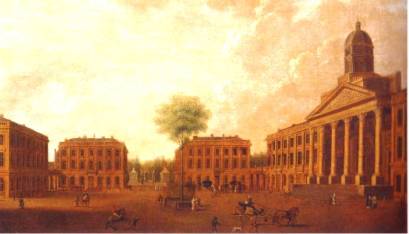
The founding of Brussels dates back to around 979 when Duke Charles passed on the relics of Saint Gudula from Moorsel to the Saint Gaugericus chapel in Brussels. Today the chapel is located on the holy island of Saint Gaugericus. On this same very island, Charles of France, the expelled son of King Louis IV, built the first permanent fortification when The Holy Roman Emperor Otto II gave the duchy of Lower Lotharingia to him. In those days, Saint Gaugericus island was recognised as the Island of Saint-Gorik. Carl of France decided to build a castrum on the island, which laid the foundation of Brussels city.
By the start of the 10th century, after the death of Charles, Low-Lorraine was taken into possession by Lambert of Leuven, Charles' son. In 1047, his son Lambert II of Leuven established the Saint Gudula chapter. He also started expanding the city by building a new castrum and fortification walls.
In the 12th century, the small town became an important stopover on the commercial road from Bruges to Cologne. The village benefited from this favourable position, and as the population started multiplying to 30,000, the nearby marshes were wiped out to allow for further expansion. Around 1183-1184 the Counts of Leuven were elevated to the position of Dukes of Brabant.
From 1357 to 1379, a new city wall was constructed as the former one was already proving to be too small: the inner ring or 'pentagon' now followed its course.
In the 15th century, due to the wedding of heiress Margaret III of Flanders with Philip the Bold, Duke of Burgundy, a new Duke of Brabant surfaced from the House of Valois, their son Antoine. Another line of descent appeared from the Habsburgs when Maximilian I of Austria married Mary of Burgundy, who was born in Brussels. Due to such sudden variations in the descendants, Brabant lost its independence, but Brussels flourished by becoming the Princely Capital of the prosperous Low Countries.
Brussels's history is closely linked to Western Europe. Traces of human settlement go back to the Stone Age. This region was also home to Roman occupation. As per the local legend, around 580, the settlement's origin, which was to become Brussels lies in Saint Gaugericus' construction of a chapel on an island in the river Senne.
The founding of Brussels dates back to around 979 when Duke Charles transferred the relics of Saint Gudula from Moorsel to the Saint Gaugericus' chapel on an island in the river Senne. Today the chapel is located in the province of East Flanders. On this island, Duke Charles, the expelled son of King Louis IV, built the first permanent fortification.
By the start of the 10th century, after the death of Charles, Low-Lorraine was taken into possession by Lambert of Leuvenm, Charles' son. In 1047, his son Lambert II of Leuven established the Saint Gudula chapter. He also expanded the city by building a new castrum and fortification walls.
In the 12th century, the small town became an important stopover on the commercial road from Bruges to Cologne. The village benefited from this favourable position, and as the population started multiplying to 30,000, the nearby marshes were wiped out to allow for further expansion. Around 1183-1184 the Counts of Leuven were elevated to the position of Dukes of Brabant.
From 1357 to 1379, a new city wall was constructed as the former was too small. The inner ring or 'pentagon' now followed its course.
In the 15th century, due to the wedding of heiress Margaret III of Flanders with Philip the Bold, Duke of Burgundy, a new Duke of Brabant surfaced from the House of Valois, their son Antoine. Another line of descent appeared from the Habsburgs when Maximilian I of Austria married Mary of Burgundy, who was born in Brussels. Due to these sudden variations in the descendants, Brabant lost its independence, but Brussels flourished by becoming the Princely Capital of the prosperous Burgundian Netherlands (known as the Seventeen Provinces).
Charles V became the Emperor of the Habsburg Empire, with Brussels as one of his main capitals since 1506. His aunt Margaret of Austria unofficially governed the empire till the year 1515. In 1516 Charles V was declared King of Spain in a ceremony conducted in the Cathedral of Saint Gudule. When Maximilian I died in 1519, Charles V became the new archduke of the Austrian Empire. However, in the year 1555, Emperor Charles V resigned. His successor Philip II had a major difference with the William of Orange, supervisor over Holland, Zealand and Utrecht. William of Orange was a broadminded ruler and did not pay much heed to Philip II's quarrels. Brussels nevertheless suffered under the cruel Duke of Alva, an official representative of Philip II. A revolution took place in Brussels, and the people, with the help of William of Orange, chased Alva away.
In 1695, Brussels was attacked by troops sent by King Louis XIV of France. The bombardment destroyed the city entirely. More than 4,000 houses, including the medieval buildings on the Grote Market or Grand Place, were destroyed. One-third of the city was razed down.
In 1830, Dutch emperor William I had to leave the Belgian country when the successful independence struggle broke out in Brussels. The Belgian revolution arose in Brussels after a performance of Auber's opera La Muette de Portici at De Munt or La Monnaie theatre.
On 21 July 1831, the first Belgian king, Leopold I, ascended the throne. Brussels became the capital of the new kingdom of Belgium. The rebuilding of Brussels began, where new and impressive buildings were built, and the city walls were pulled down. International congresses were arranged, and scientific organisations were established.
During World War I, Brussels was occupied by German troops, but they didn't cause much damage. During World War II, German troops again occupied it and caused substantial damage. After the war, plans were implemented to restructure the city. In 1967 Brussels became the headquarters of NATO. The underground tram service was started in 1969, and the metro was launched in 1976. New buildings and modern offices were erected to accommodate EU integration.On 18 June 1989, Brussels Capital Region was founded with its government and capital. In 2001 Brussels officially became the Capital of Europe, and the Euro currency came into place. New industries and plants continued spurting up, resulting in difficulty balancing historical treasures and modern infrastructure.
In 2000, Brussels was named the European Capital of Culture. In 2013, Brussels Agreement took place in the city. In 2014, Brussels hosted the 40th G7 summit. Brussels also hosted NATO Summits in 2017, 2018 and 2021.On 22 March 2016, ISIL carried out terrorist attacks at Brussels Airport in Zaventem and Maalbeek metro station. Thirty-two civilians were killed, and more than 300 people were injured. It was the deadliest act of terrorism in Belgium.